
How to A/B Test
As the Editor in Chief of the Editorial Staff here at GlowStar Digital, I help business owners make Google Ads changes based on evidence, not assumptions.
I created this guide to show you exactly how to A/B test Google Ads using Experiments, so you can maximize your ROI.
This guide will show you how to:
- Set up Google Ads Experiments correctly
- Test ads, audiences, bids, and creatives without risking your entire account
- Measure results using conversion rate, CPA, CTR, and revenue impact
- Make data driven decisions backed by statistical significance
If you want to know how to A/B test Google Ads properly and avoid common mistakes, this next section is for you:
A/B Test Example for Google Ads:
Example Situation:
A local landscaping company wants more phone calls and form submissions for services like lawn care and yard cleanup.
The campaign is already generating leads, but the goal is to increase conversion volume while keeping CPA stable or lower.
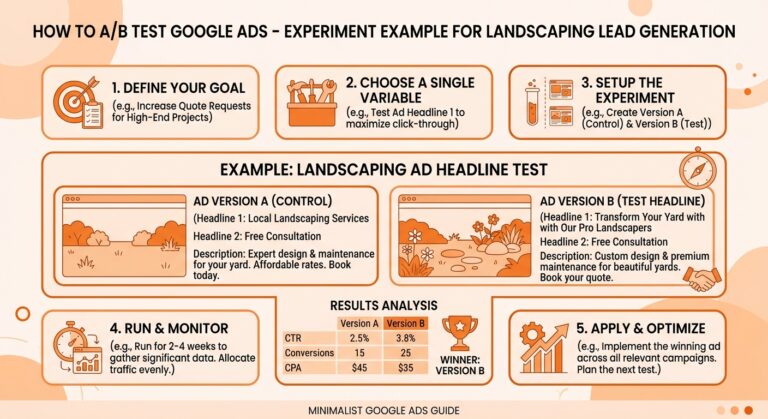
Step 1: Define the Goal
The objective of this A/B test is to increase conversion rate without increasing CPA.
Primary metrics:
- Conversions
- Cost Per Acquisition (CPA)
Secondary metrics:
- Click Through Rate (CTR)
Step 2: Select One Element to Test
Only ad copy messaging is tested. All other elements remain unchanged, including:
- Keywords
- Bids
- Budget
- Location targeting
- Landing page
This ensures clean experimentation and reliable insights.
Step 3: Control Ad
The control uses general, trust based messaging.
Control Headlines
- Professional Landscaping Services
- Trusted Local Lawn Care
- Free Estimates Available
Description
Reliable landscaping services for homes and businesses. Call today for a free quote.
Step 4: Experiment Ad
The experiment introduces local personalization and urgency.
Experiment Headlines
- Landscaping Services in [City]
- Same Week Lawn Service
- Call for a Free Quote
Description
Local landscaping experts serving [City]. Fast scheduling and upfront pricing. Call now.
Step 5: Launch the Google Ads Experiment
Inside Google Ads Experiments:
- Create an experiment from the original campaign
- Change only the ad copy
- Split traffic 50 percent control, 50 percent experiment
- Run the test for 21 to 28 days
This provides enough data for statistically valid lead generation results.
Step 6: Measure Results
Review performance weekly but make no changes during the test.
Key metrics to evaluate:
- Conversion rate
- CPA
- Total leads
- CTR
Example outcome:
- Conversion rate increases by 18 percent
- CPA drops from $72 to $59
- CTR improves from 6.1 percent to 7.4 percent
Step 7: Apply the Winner
Apply the winning version permanently and document:
- Hypothesis
- Variable tested
- Results
This creates a repeatable A/B testing framework for landscaping lead generation.
How Do You A/B Test Google Ads?
We A/B test Google Ads by using Google Ads Experiments to split traffic between a control and a variation, then comparing performance using predefined success metrics like conversions, CPA, CTR, and revenue.
What Should You A/B Test in Google Ads?
Focus on one variable at a time to isolate impact and maintain clean results.
Ad Copy Variations
Test headlines, descriptions, value propositions, CTAs, and keyword insertion. Even small copy changes can significantly affect CTR and conversion rate.
Visuals and Design
For display, demand gen, and performance max campaigns, test imagery, video thumbnails, colors, and creative formats. Interactive and personalized visuals often increase engagement wins.
Audience Targeting
Test:
- Broad versus segmented audiences
- In market versus custom intent
- Geographic personalization like city based H1s
Ignoring audience segmentation is a common testing pitfall.
Bid Management Strategies
Compare manual CPC, maximize conversions, target CPA, and value based bidding. Bid strategy experiments often reveal hidden efficiency gains.
How to Set Up Google Ads Experiments
Google Ads includes native experimentation tools designed for advertisers and stakeholders.
Navigating the Experiment Interface
Inside Google Ads, go to Experiments and select the campaign you want to test. Choose how much traffic to split and how long the experiment will run.
Creating and Launching Tests
Define:
- A clear hypothesis
- The variable being tested
- Success metrics such as CPA, conversions, or revenue
- Sample size and test duration
Launch only after conversion tracking is verified.
What Metrics Should You Use in A/B Testing?
Choose relevant metrics that align with business impact, not vanity metrics.
Conversion Rate
Measures how effectively traffic turns into leads or sales. A landing page converting at 2 percent should be tested aggressively.
Click Through Rate
CTR indicates ad relevance and message match. A low CTR often signals weak copy or poor targeting.
Cost Per Acquisition
CPA determines profitability. A test that increases conversions but raises CPA beyond acceptable thresholds is not a win.
Revenue and Lead Quality
Some experiments lower conversion rate but increase lead quality by over 200 percent. That can still be a successful outcome.
How Long Should an A/B Test Run?
Run tests long enough to achieve statistical significance and stable data.
Determining Optimal Test Length
Most Google Ads experiments require at least two to four weeks, depending on traffic volume and conversion frequency.
Considering External Factors
Account for seasonality, promotions, budget changes, and demand shifts. Ending tests too early leads to false insights.
How to Analyze A/B Test Results
Use dashboards, BI reports, or built in experiment summaries to evaluate outcomes.
Evaluating Performance Objectively
Look at cumulative impact, win rates, and confidence intervals. Avoid cherry picking short term fluctuations.
Making Data Driven Decisions
Only roll out changes when results are consistent, statistically valid, and aligned with north star metrics.
Common A/B Testing Mistakes to Avoid
Many experiments fail due to process issues, not strategy.
- Testing multiple variables at once
- Ending tests early without enough sample size
- Misinterpreting results based on CTR alone
- Ignoring customer experience and long term revenue
- Failing to document experiments and insights
Experimentation without documentation limits learning velocity.
Best Practices for Google Ads A/B Testing
Effective experimentation supports AI learning, smarter optimization, and confident releases.
- Test one variable at a time
- Define hypotheses clearly
- Use meaningful business metrics
- Ensure proper sample size
- Share insights with stakeholders
A/B testing is not just about winning experiments. It is about building a system that continuously refines performance, improves customer experience, and drives sustainable growth.
A/B testing improves marketing optimization, decision making, and long term account performance.
- One onboarding experiment increased trial to paid conversion by 8 percent
- Some variations drive lower short term conversions but 23 percent higher lifetime value
- Creative quality accounts for roughly 50 percent of campaign effectiveness
- 73 percent of consumers prefer ads that feel personally relevant
Without experimentation, advertisers risk optimizing for the wrong outcomes.

Subscribe